What Color Are Bed Bugs? By Stage & Feeding (2026)
What color are bed bugs? Adults are reddish-brown, but color shifts with feeding (redder and darker after a meal) and life stage (eggs and young nymphs are pale or translucent). Learn the full color picture.
Disclosure: As an Amazon Associate we earn from qualifying purchases. Some links on this page are affiliate links: they cost you nothing extra and do not change what we write. Read our affiliate disclosure.
When trying to identify these pests, a basic question is what color are bed bugs? The short answer is that adult bed bugs are reddish-brown, but their color is not fixed — it changes noticeably with feeding (a recently-fed bug looks redder and darker, even swollen) and varies by life stage (eggs and newly-hatched nymphs are pale, whitish, or translucent, becoming more brown as they grow). So there is no single bed bug color; it depends on the stage and whether the bug has fed.
Knowing the color range matters for identification, because a description of just “reddish-brown” can lead you to overlook the pale, translucent young nymphs or the bright-red engorged fed bug, both of which look quite different. Understanding how color shifts with feeding and age helps you recognize bed bugs at every stage and avoid confusing them with other insects.
In this guide you will learn what color bed bugs are at each life stage, how feeding changes their color, how color helps with identification, and how it compares to look-alike insects. We will use clear tables and finish with a printable checklist. 💚
- What Color Are Bed Bugs? Quick Answer
- Adult Bed Bug Color
- How Feeding Changes Their Color
- Bed Bug Color by Stage and Feeding
- The Color of Eggs
- The Color of Nymphs
- A Fed Bug Looks Different
- Using Color to Identify Bed Bugs
- Color vs Look-Alike Insects
- The Colors of Their Stains
- Color and Inspection
- Common Mistakes (and Fixes)
- Expert Pro Tips
- FAQs
- Final Verdict + Checklist
What Color Are Bed Bugs? Quick Answer
The quick answer is that adult bed bugs are reddish-brown, but their color is not fixed. It changes with feeding — a recently-fed bug looks redder, darker, and swollen, while an unfed one is a flatter, lighter brown — and it varies by life stage: eggs and newly-hatched nymphs are pale, whitish, or translucent, becoming more tan and then brown as they grow and feed. So there is a range of colors, not a single bed bug color.
This matters for identification, because looking only for a “reddish-brown bug” can cause you to miss the pale, translucent young nymphs (which look almost colorless) or the bright-red engorged fed bug (which looks swollen and vivid). Knowing the full color range — pale eggs and young nymphs, tan to reddish-brown adults, and the redder, darker appearance after feeding — helps you recognize bed bugs at every stage. Our guide on what bed bugs look like covers appearance alongside color.
Adult bed bugs are reddish-brown, but color changes with feeding (redder/darker when fed) and life stage (eggs and young nymphs are pale or translucent). There is a range, not one fixed color.
Adult Bed Bug Color
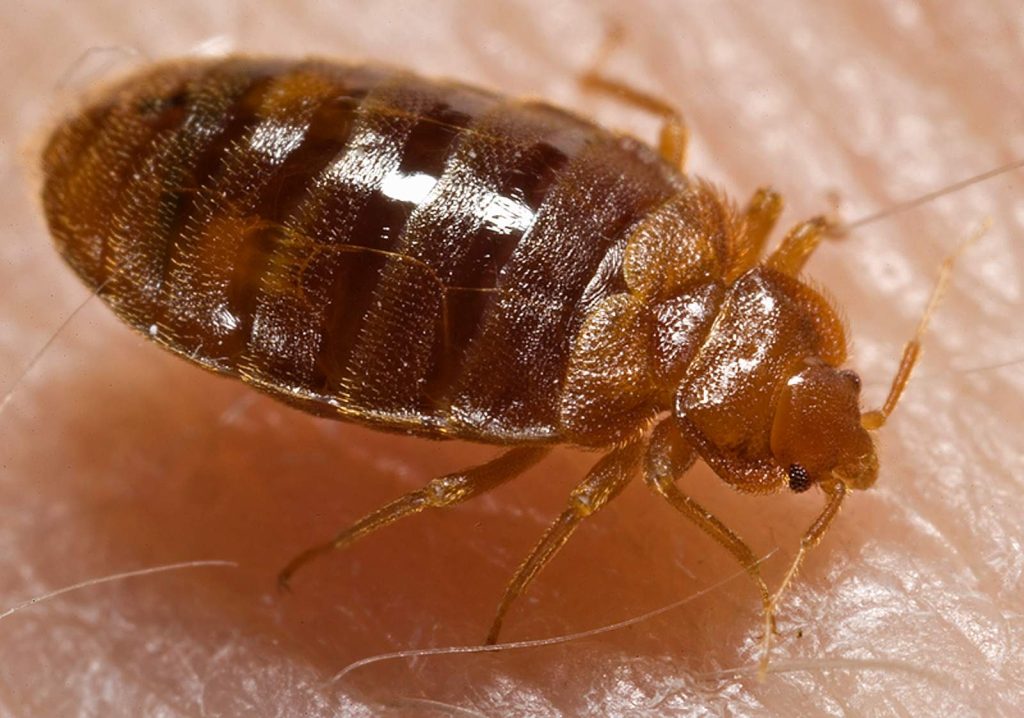
Adult bed bugs are reddish-brown — the classic bed bug color. An unfed adult is a flatter, more uniform brown, sometimes described as mahogany or rusty brown. This is the color most people picture and the one in typical identification images: a small, flat, oval, reddish-brown insect about the size of an apple seed.
The exact shade can vary a bit between individuals and with how recently the bug fed (covered next), but reddish-brown is the baseline adult color. After a blood meal, the adult becomes redder and darker; when unfed and flat, it is a lighter, drier brown. So even within adults, the color shifts with feeding state.
So when identifying an adult bed bug, expect a reddish-brown, flat, oval insect — but remember the shade depends on feeding. The reddish-brown adult is the reference point, with the pale young stages and the engorged fed appearance as the variations around it. Our guide on how big bed bugs are covers adult size alongside color.
How Feeding Changes Their Color
Feeding noticeably changes a bed bug color, which is one of the most important things to understand. An unfed bed bug is a flatter, lighter brown. After it feeds on blood, it becomes redder and darker — the fresh blood gives it a reddish or even bright-red tint, and as the blood digests, it darkens toward a darker reddish-brown or near-black. The bug also swells and lengthens, so it looks both differently colored and differently shaped after feeding.
This means the same bug can look like a flat light-brown insect when unfed and a swollen, vivid reddish bug right after a meal. People sometimes mistake a recently-fed bed bug for a different insect because it looks so different from the flat brown reference image — redder, rounder, and darker. Recognizing that a fed bug is redder and darker prevents this confusion.
So feeding state is a major factor in bed bug color: unfed = flatter, lighter brown; recently fed = redder, swollen; digesting = darker reddish-brown. The color (and shape) you see depends on when the bug last fed. This is why color descriptions must account for feeding. Our guide on bed bug feeding covers the feeding that drives the color change.
Bed Bug Color by Stage and Feeding
| Stage / State | Color |
|---|---|
| Eggs | Pearly white to translucent |
| Newly-hatched nymph (unfed) | Pale, whitish, or translucent |
| Nymph after feeding | Reddish or with a visible red blood blob |
| Older nymph | Tan to light brown, darkening with age |
| Adult (unfed) | Flat, reddish-brown / mahogany |
| Adult (recently fed) | Redder, darker, swollen |
Bed bug color ranges from pale eggs and young nymphs to reddish-brown adults, redder and darker after feeding.
The Color of Eggs
Bed bug eggs are pearly white to translucent — pale and not at all reddish-brown. They are tiny (about 1mm, the size of a pinhead or grain of salt) and have a whitish, slightly translucent appearance, often laid in clusters in hidden crevices. Because they are so pale and small, they are easy to overlook, especially against light-colored surfaces.
This pale color is a reason eggs are hard to spot and why a “reddish-brown bug” search misses them — the eggs are a completely different, pale color. To find eggs, you look for tiny, whitish, translucent specks in seams and crevices, often clustered, rather than the reddish-brown of the bugs. Good light and sometimes magnification help, given their small size and pale color.
So the egg color — pearly white/translucent — is part of the bed bug color range and important for inspection. Finding eggs (the next generation) matters, and knowing they are pale, not reddish-brown, helps you recognize them. Our guide on bed bug eggs covers their appearance.
The Color of Nymphs
Nymphs (immature bed bugs) range in color as they grow. A newly-hatched nymph is pale, whitish, or translucent — almost colorless — which makes it very hard to see, especially before it has fed. As nymphs grow through their stages and feed, they become more tan, then light brown, and eventually the reddish-brown of adults. So nymph color shifts from pale to brown with age.
A key point: after a nymph feeds, it shows a visible red or dark blob of blood inside its translucent body, which can make a recently-fed nymph briefly easier to spot (the red blood shows through the pale body). So an unfed nymph is pale and hard to see, while a fed one shows red. This is a useful identification clue.
So nymphs span from translucent/pale (young, unfed) to reddish-brown (older), with the red blood blob visible after feeding. The pale young nymphs are easy to miss in a “reddish-brown” search, which is why knowing the full color range matters. Our guide on baby bed bugs and nymphs covers their appearance.
A Fed Bug Looks Different
It is worth emphasizing that a recently-fed bed bug looks different enough in color (and shape) that it is a common source of misidentification. After feeding, the bug is engorged with blood — redder, darker, swollen, and elongated — quite unlike the flat, light-brown unfed reference image. People sometimes think a fed bed bug is a different bug entirely because of this dramatic change.
So if you find a plump, reddish or dark, swollen bug near the bed, do not dismiss it as “not a bed bug” because it is not the flat brown you expected — it may simply be a recently-fed bed bug. The same applies to nymphs with a red blood blob. The fed appearance is normal and expected as part of their color range.
Recognizing the fed appearance — redder, darker, swollen — prevents both missing fed bugs and misidentifying them. Combined with the flat reddish-brown unfed look and the pale young stages, it completes the color picture you need for reliable identification. Our guide on the blood in a fed bug covers the red coloration.
Using Color to Identify Bed Bugs
Color is a useful identification clue when combined with size and shape, but it must account for the full range. A flat, reddish-brown, oval, apple-seed-sized insect is the classic adult; a swollen, redder, darker version is a fed adult; pale, translucent tiny specks (clustered) are eggs; and pale to tan small insects (sometimes with a red blood blob) are nymphs. Recognizing all these as bed bugs at different stages and feeding states is key.
So do not rely on a single color — use the range. If you find pale young nymphs but no reddish-brown adults, it is still bed bugs; if you find a swollen red bug, it is likely a fed bed bug; if you find pale clustered eggs, those are bed bug eggs. The color clues, together with the flat oval shape and the size, give a reliable identification across stages.
For certainty, capturing a specimen and having it identified (or comparing carefully to reliable images of each stage) confirms it, since color alone can overlap with some other insects. But understanding the bed bug color range lets you recognize them at every stage during inspection. Our guide on catching a bug for identification covers confirming the pest.
| Insect | Color | Key Difference from Bed Bugs |
|---|---|---|
| Bed bug (adult) | Reddish-brown (redder when fed) | Flat, oval, apple-seed size, wingless |
| Young cockroach | Brown to reddish-brown | Faster, longer body, often with stripe |
| Carpet beetle larva | Tan to brown, fuzzy | Hairy/bristly body, not flat and smooth |
| Bat bug | Reddish-brown (near-identical) | Needs magnification; longer hairs on body |
| Spider beetle | Reddish-brown to dark | Rounder, shiny, spider-like legs |
Reddish-brown color overlaps with several insects, so color must be combined with shape, size, and context.
Color vs Look-Alike Insects
Color helps distinguish bed bugs from some look-alikes, though it overlaps with others, so use it alongside shape and behavior. Several insects are reddish-brown or brown and can be confused with bed bugs — like young cockroaches, carpet beetles, or bat bugs — so reddish-brown color alone does not confirm a bed bug. Conversely, a silvery insect (silverfish) or a clearly different color points away from bed bugs.
So while the reddish-brown color (and the pale young stages) is consistent with bed bugs, you should combine it with the distinctive flat, oval, apple-seed shape, the size, the lack of wings, and the behavior/location (near the bed) to distinguish bed bugs from similarly-colored insects. Color is one clue among several, not a sole identifier.
For example, a reddish-brown insect with a very different shape (elongated, or with prominent wings or a distinctive pattern) is likely a different pest, while a flat, oval, reddish-brown, wingless insect near the bed fits bed bugs. Using color plus shape, size, and context, and confirming with identification, distinguishes them reliably. Our guide on bugs that look like bed bugs covers the look-alikes.
The Colors of Their Stains
Beyond the bugs themselves, bed bugs leave colored evidence that aids identification. Their fecal spots are dark — reddish-brown to black, ink-like marks (digested blood) — found on bedding, mattresses, and in harborages. Blood stains from crushed fed bugs or feeding are reddish. Shed skins are translucent, pale, empty exoskeletons. Eggs are pearly white. So the evidence has its own telltale colors.
These colored signs are often easier to find than the bugs and confirm an infestation: dark fecal staining is a hallmark, the pale shed skins and eggs accumulate in harborages, and reddish blood stains can appear on sheets. So the colors of the evidence — dark fecal spots, reddish blood, pale skins and eggs — are part of the bed bug color picture for detection.
So when inspecting, look not just for the bugs colors but for the dark fecal spots, reddish stains, pale shed skins, and white eggs. This colored evidence, against lighter surfaces, is often the clearest sign of bed bugs. Knowing these colors helps you recognize the evidence. Our guide on bed bug fecal stains covers the dark staining.
Color and Inspection
Understanding bed bug colors improves your inspection. Because the bugs and evidence span pale (eggs, young nymphs, shed skins) to reddish-brown (adults) to dark (fecal spots), inspecting against contrasting backgrounds and with good light helps: dark bugs and fecal spots show against light surfaces (like a white mattress or encasement), while pale eggs and nymphs are easier to spot against darker surfaces or with magnification.
A bright flashlight reveals the colors in the crevices, and a white mattress encasement provides a contrasting surface where any bugs (and dark stains) stand out. A magnifier helps confirm the pale, tiny eggs and young nymphs that are hard to see by color alone. So leveraging the color contrast aids detection across all the stages.
So use color knowledge in inspection: look for dark fecal spots and reddish-brown bugs against light surfaces, pale eggs and nymphs with good light and magnification, and the full range in the harborages. A detection flashlight (view on Amazon) and a white mattress encasement (see options on Amazon) make the colors easier to spot. Our guide on finding bed bugs covers inspection.
Common Mistakes (and Fixes)
- Mistake: Looking only for reddish-brown bugs. Fix: also look for pale eggs and translucent young nymphs.
- Mistake: Dismissing a swollen red bug as not a bed bug. Fix: that is likely a recently-fed bed bug — redder and darker after feeding.
- Mistake: Confirming bed bugs by color alone. Fix: combine color with shape, size, and context, and confirm with identification.
- Mistake: Missing pale nymphs against light surfaces. Fix: use good light and magnification; check darker backgrounds.
- Mistake: Ignoring the colored evidence. Fix: look for dark fecal spots, reddish stains, pale skins, and white eggs.
Expert Pro Tips
- Know the full color range. Pale eggs and young nymphs to reddish-brown adults.
- Account for feeding. A fed bug is redder, darker, and swollen.
- Use color with shape and size. Color alone overlaps with look-alikes.
- Leverage contrast. Dark bugs and stains show on light surfaces; pale stages need good light.
There is no single bed bug color — pale eggs and young nymphs, reddish-brown adults, and a swollen vivid red after a blood meal. Know the whole range, or you will miss the pale young and mistake the fed for something else.
Real-Life Scenarios
The pale nymphs. Maya searched for reddish-brown bugs and found none, but pale, translucent young nymphs were present in the seam — a different color she had overlooked. Knowing the range, she recognized them.
The swollen red bug. Tom found a plump, vivid reddish bug and almost dismissed it as not a bed bug, but it was a recently-fed adult — redder and swollen from its meal.
The colored evidence. Lena spotted dark, ink-like fecal stains and pale shed skins in the harborage before she saw a single bug — the colored evidence confirmed the infestation.
Frequently Asked Questions
What color are bed bugs?
Adult bed bugs are reddish-brown, but their color changes with feeding (redder, darker, and swollen after a meal) and varies by life stage (eggs and newly-hatched nymphs are pale, whitish, or translucent, becoming tan then brown as they grow). So there is a color range, not a single fixed color.
What color are bed bugs after they feed?
Redder and darker. A recently-fed bed bug is engorged with blood, giving it a reddish or bright-red tint that darkens toward dark reddish-brown as the blood digests, and it swells and elongates. So a fed bug looks quite different — redder, darker, and swollen — from the flat, lighter-brown unfed bug.
What color are baby bed bugs (nymphs)?
Newly-hatched nymphs are pale, whitish, or translucent — almost colorless — which makes them hard to see. As they grow and feed, they become tan, then light brown, then reddish-brown. After feeding, a nymph shows a visible red blood blob through its pale body, making it briefly easier to spot.
What color are bed bug eggs?
Bed bug eggs are pearly white to translucent — pale, not reddish-brown. They are tiny (about 1mm), often laid in clusters in hidden crevices, and easy to overlook because of their small size and pale color. Good light and magnification help spot them.
Can I identify bed bugs by color alone?
Not reliably — reddish-brown color overlaps with some other insects (young cockroaches, carpet beetles, bat bugs), and bed bug color varies by stage and feeding. Use color alongside the flat oval shape, apple-seed size, lack of wings, and location near the bed, and confirm with identification for certainty.
What color are bed bug stains?
Their fecal spots are dark reddish-brown to black, ink-like marks (digested blood); blood stains from crushed fed bugs are reddish; shed skins are translucent and pale; and eggs are pearly white. This colored evidence, against lighter surfaces, is often the clearest sign of an infestation.
Final Verdict + Checklist
What color are bed bugs? Adults are reddish-brown, but there is no single bed bug color — it changes with feeding and life stage. An unfed adult is a flatter, lighter reddish-brown; a recently-fed one is redder, darker, and swollen; eggs and newly-hatched nymphs are pale, whitish, or translucent; and nymphs darken from pale to brown as they grow, showing a red blood blob after feeding. So for identification, know the full range: pale eggs and young nymphs, reddish-brown adults, and the redder, darker fed appearance — and combine color with the flat oval shape, size, and location, plus the dark fecal stains, reddish blood, and pale shed skins of their evidence. Use good light and contrast, and confirm with identification.
- Know adults are reddish-brown — but color is not fixed
- Account for feeding — fed bugs are redder, darker, swollen
- Look for pale, translucent young nymphs (not just brown bugs)
- Recognize pearly-white eggs in clusters
- Watch for the red blood blob in fed nymphs
- Use color with shape, size, and location — not alone
- Look for dark fecal spots, reddish stains, and pale shed skins
- Leverage contrast — dark on light surfaces, pale with good light
- Confirm with identification when unsure
Further reading from public agencies
These are United States agencies. If you are elsewhere, check your national or local public-health or pest-control authority. This article is general information, not medical advice or a diagnosis.